
Guide
What Makes Sunglasses Unisex? Men's vs Women's Frames
GlareBear November 27, 2026 4 min read
The short answer
Unisex sunglasses are frames the maker or seller labels for anyone, usually because the shape and size are neutral: a medium lens of about 52 to 56 mm and a classic outline such as round, rectangle or pilot. There is no official standard behind the label. Fit depends on the three size numbers, so a pair labelled men's or women's can suit you just as well if the numbers match your face.
Unisex is a label, not a size
No eyewear standard defines a men's, women's or unisex frame. The label comes from the maker or the seller and describes who the design is aimed at. Makers differ: the same shape can be sold as women's by one brand and unisex by another. What actually decides whether a pair fits is printed inside the arm as three numbers, such as 54-17-145: lens width, bridge width and arm length, all in millimetres. Our guide to reading sunglasses sizes explains each one.
Men's vs women's vs unisex frames
The differences are tendencies, not rules. This is how the three labels usually compare:
| Often labelled men's | Often labelled women's | Often labelled unisex | |
|---|---|---|---|
| Typical shapes | Pilot, rectangle, wraparound sport | Cat-eye, oversized, butterfly | Round, rectangle, pilot, keyhole |
| Detailing | Plain, darker colours | More decoration, lighter or bolder colours | Plain or quietly branded |
| Median lens width in our range | 56 mm | 55 mm | 54 mm |
| Middle half of our range | 54 to 59 mm | 53 to 57 mm | 53 to 58 mm |
The size rows come from the pairs we list with a stated lens width, counted in late November 2026. The gap between the labels is only a millimetre or two at the middle. Each label also covers small and large frames, so the label alone tells you little about fit.
What makes a frame read as unisex
- A classic outline. Round, rectangle and pilot shapes have been worn by everyone for decades.
- A medium lens. Many unisex pairs sit in the medium 52 to 56 mm band, which suits a wide range of faces.
- Neutral colour. Black, havana (tortoiseshell), silver and gunmetal frames with grey, green or brown lenses.
- Restrained branding. A name on the arm rather than large logos or crystals on the front.
Unisex pairs worth a look
All six are listed as unisex. Sizes and details are from each pair's own page:
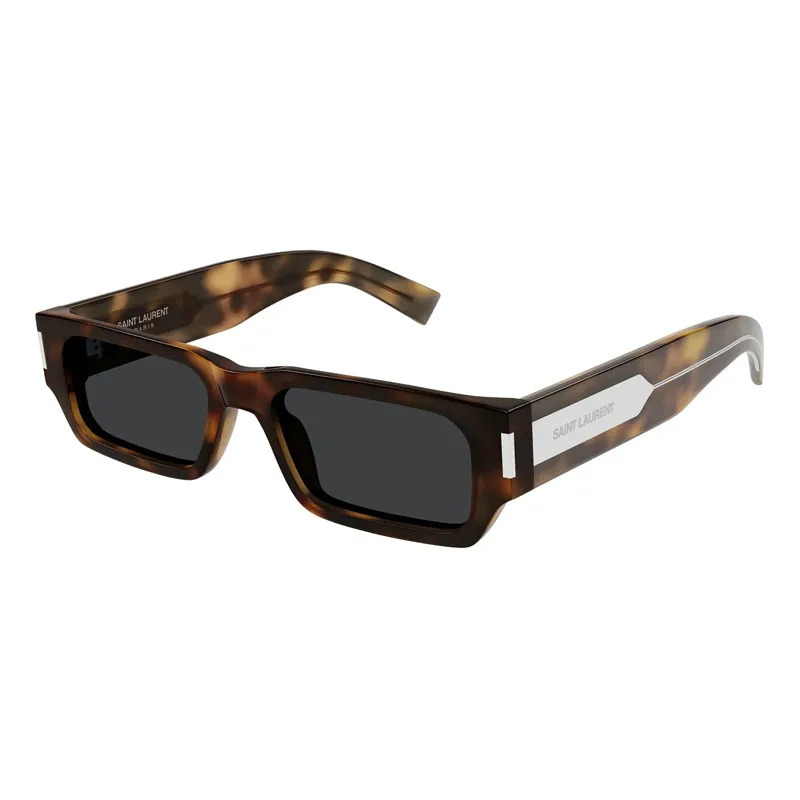
- Saint Laurent SL660 in Havana: a thick, low acetate rectangle with grey lenses and silver lettered plates on the arms, 54-17-145.
- Celine CL40297U in Havana: a dark tortoiseshell rectangle with green lenses and three small dots at each corner, 53-18-150.
- Levi's LV1028/S in Palladium: a near-round silver wire frame with flat grey lenses, a straight bar and nose pads, 54-21-140.
- Carrera 301/S in Blue: a see-through blue acetate round with a keyhole bridge, a compact 50-23-145.
- Adidas OR0102 in White: an all-white plastic round with dark Blue Smoke lenses, 53-20-145.
- Bottega Veneta BV1194S in Ruthenium: a faceted gunmetal pilot with a double bridge and grey lenses, a wide 61-12-145.
How to choose by fit instead of label
- Find a pair you already like and read the three numbers inside the arm.
- Look for a lens width within 2 or 3 mm of it. Wider faces usually suit 57 mm and up; narrow faces often suit 51 mm or less.
- Check the bridge. A wider bridge, around 20 mm or more, suits a broader nose; a narrower one suits a slim nose.
- Pick the shape for your face, using our face shape guide.
- Then browse every label: unisex, men's and women's.
If you are not sure of your size, our guide to measuring your face at home takes a few minutes with a ruler.
FAQ
Can a woman wear men's sunglasses?
Yes. The label is about styling, not fit. If the lens width, bridge and arm length match your face, a pair sold as men's will fit just as well.
Are unisex sunglasses smaller than men's?
Slightly, on average, in our range: the median unisex lens is 54 mm against 56 mm for men's. Individual pairs vary far more than that, so check the numbers on each pair.
What sunglasses shapes are unisex?
Round, rectangle and pilot shapes are the ones most often sold as unisex. Cat-eye and butterfly shapes are more often labelled women's, though some makers sell them as unisex too.
Is there a standard for unisex sunglasses?
No. Each maker or seller decides the label, which is why the same style can be listed differently in different places.
More guides
- Lens Categories 0 to 4: How Dark Should Sunglasses Be?What sunglasses lens categories 0 to 4 mean, how much light each lets through, where each one fits, and why darker is not the same as UV protection.Read the guide
- Titanium vs Acetate vs Nylon Frames: Which Is Lightest?Nylon is the lightest material, but a thin titanium frame can weigh less than either plastic. How titanium, acetate and nylon frames compare.Read the guide
- Best Sunglasses for Driving: What to Look ForFor driving, pick grey or brown lenses in category 2 or 3, slim temples and a snug fit. Compare lens options and see pairs that suit the road.Read the guide