
Guide
Lens Categories 0 to 4: How Dark Should Sunglasses Be?
GlareBear November 26, 2026 4 min read
The short answer
Lens categories run from 0 (almost clear) to 4 (very dark) and measure how much visible light the lens lets through. Category 2 suits mixed or moderate sun, category 3 suits bright everyday sun, and category 4 is for extreme glare such as snow or high mountains and must not be used for driving. Darkness says nothing about UV protection, which is rated separately.
What the category number measures
The category is a filter rating from the European and international sunglasses standard (EN ISO 12312-1). It is based on luminous transmittance: the share of visible light that gets through the lens. A lower share means a darker lens and a higher category number. Australia and New Zealand use the same 0 to 4 scale. The US standard sorts sunglasses differently, so pairs made mainly for the US market often carry no category number at all.
The five categories side by side
| Category | Visible light let through | Looks like | Typical use |
|---|---|---|---|
| 0 | 80 to 100 percent | Clear or very pale tint | Fashion wear, indoors, overcast days |
| 1 | 43 to 80 percent | Light tint | Dull or cloudy days, low sun |
| 2 | 18 to 43 percent | Medium tint | Moderate sun, mixed light |
| 3 | 8 to 18 percent | Dark tint | Bright sun, the usual everyday sunglasses lens |
| 4 | 3 to 8 percent | Very dark | Snow, glaciers, high mountains, very strong glare. Not for driving |
Darker is not the same as UV protection
The category only describes visible light. Ultraviolet protection is a separate test, so a dark lens is not automatically a safe one, and a pale lens can still block UV. A dark lens without UV filtering can be worse than none, because your pupils open wider behind it. Our guide to what UV400 means covers that side. Polarization is also separate from the category; see polarized or not.
How dark should your sunglasses be?
- Everyday bright sun: category 3 is the common choice for summer, the beach and open roads in daylight.
- Mixed light or a lot of time in shade: category 2 is easier when you move between sun and shade.
- Snow, water at altitude or mountain trips: category 4 exists for this, but keep a lighter pair for the drive.
- Dusk and night: skip tinted lenses. Under the European standard, lenses that let through less than 75 percent of light are marked as not suitable for twilight or night driving.
- Driving in daylight: the standard rates categories 0 to 3 as suitable; category 4 is the one to avoid. Our driving guide goes further.
Where to find the category on a pair
Makers that rate to the European standard usually print the category on the inside of an arm, often near the CE mark, as "Cat. 3" or just a number, and repeat it in the leaflet in the case. Makers differ in where they put it, and some leave it off. If a pair you own carries no number, the lens colour alone cannot tell you the category: two dark grey lenses can test differently.
Shades in our range, lightest to darkest
Our product pages list each pair's lens colour, not a category, so we make no category claim for any pair. These five simply show the range of lens shades, judged by the listing and the photos:
- Nike RUNX2D in White/Black: a men's wraparound with a single clear lens, 72-11-130.
- Gucci GG1528S in Light Grey: a pale grey acetate rectangle with clear lenses, 53-18-145.
- Michael Kors MK2246U in Black: a grey gradient, dark charcoal at the top fading to light smoky grey at the bottom, 54-17-140.
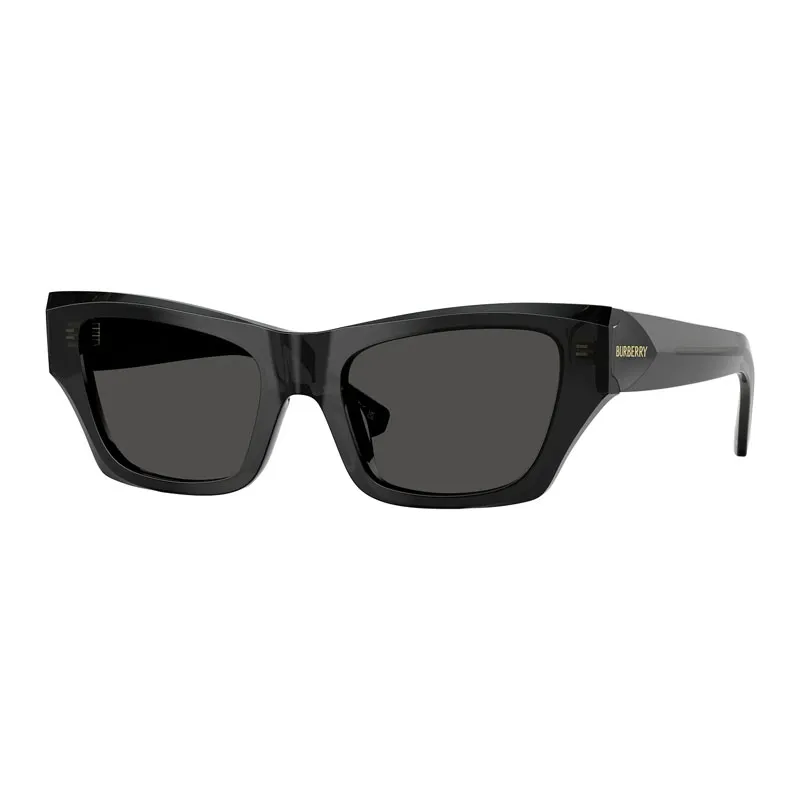
- Burberry BE4441U in Grey: an even dark grey solid tint with no gradient or mirror, 52-19-140.
- Saint Laurent SL 303 Jerry in Black: near-black lenses in a thin triangular wire frame, 58-13-145.
A gradient lens is darker at the top than the bottom, so its shade changes with where you look. Our guide to gradient lenses explains when that helps. For colour choices, see lens colours explained, or browse women's, men's and unisex sunglasses.
FAQ
What lens category is best for everyday use?
Category 3 is the usual everyday sunglasses lens for bright sun. Category 2 suits people who spend more time in mixed light or shade.
Can I drive with category 4 sunglasses?
No. Category 4 lenses let through so little light that the standard marks them as not suitable for driving or road use.
Does a darker lens protect my eyes from UV better?
Not by itself. The category measures visible light only, and UV protection is tested separately, so check for a UV rating as well as the darkness.
Does lens colour tell me the category?
Only roughly. A clear lens is category 0 and a near-black lens is likely to be dark, but the category comes from a measurement, so two lenses of the same colour can be rated differently.
Is category 0 still a pair of sunglasses?
Category 0 lenses are clear or nearly clear and are made for looks or low light. They are not meant to cut sun glare.
More guides
- What Makes Sunglasses Unisex? Men's vs Women's FramesWhat the unisex label on sunglasses means, how men's, women's and unisex frames really differ in size and shape, and how to pick by fit instead.Read the guide
- Titanium vs Acetate vs Nylon Frames: Which Is Lightest?Nylon is the lightest material, but a thin titanium frame can weigh less than either plastic. How titanium, acetate and nylon frames compare.Read the guide
- Best Sunglasses for Driving: What to Look ForFor driving, pick grey or brown lenses in category 2 or 3, slim temples and a snug fit. Compare lens options and see pairs that suit the road.Read the guide