
Guide
Titanium vs Acetate vs Nylon Frames: Which Is Lightest?
GlareBear November 25, 2026 6 min read
The short answer
Nylon is the lightest of the three materials, at about 1.0 to 1.15 grams per cubic centimetre, against about 1.3 for acetate and about 4.5 for titanium. As a finished frame, a thin titanium wire frame or a slim nylon frame is usually the lightest, because titanium is strong enough to need very little material. Acetate frames are usually the heaviest of the three, because the rims are thick and solid.
What each material is
Titanium is a metal. It weighs about 4.5 grams per cubic centimetre, a little over half the weight of stainless steel at about 7.9. It is strong for its weight, so rims and arms can be drawn very thin, and it resists corrosion from sweat and salt water. Pure titanium contains no nickel. Beta titanium is a titanium alloy that flexes more. Makers differ: some frames are titanium throughout, some use it only for certain parts, and many product listings only say metal.
Acetate is cellulose acetate, a plastic made from plant fibre. Frames are usually cut from flat sheets and polished, which gives thick rims with colour and pattern running through the material. It weighs about 1.3 grams per cubic centimetre.
Nylon is a family of plastics also called polyamide. Names such as TR-90 and Grilamid are trade names for nylon-type frame plastics. Nylon is melted and injected into a mould, so it can form thin, curved and wrapped shapes. It weighs about 1.0 to 1.15 grams per cubic centimetre, it flexes, and it stands up well to knocks, which is why many sport frames use it.
Titanium, acetate and nylon side by side
| Point | Titanium | Acetate | Nylon |
|---|---|---|---|
| Weight of the material | About 4.5 g per cubic cm | About 1.3 g per cubic cm | About 1.0 to 1.15 g per cubic cm |
| How frames are made | Thin wire and sheet, joined and coated | Cut from sheet, then polished | Injected into a mould |
| Typical look | Very thin rims, wire shapes, rimless | Thick rims, bold outline | Slim to medium rims, wraps and shields |
| Weight of a typical frame | Among the lightest | Usually the heaviest of the three | Among the lightest |
| Colour | Metal tones and coatings | Deep colours and patterns such as havana | Solid, matte and clear colours |
| Nose | Usually small pads that can be moved | Usually a fixed bridge | Usually a moulded bridge, sometimes with rubber pads |
| Adjusting | An optician can bend it with care | An optician warms it and bends it | The least adjustable, it tends to spring back |
These are tendencies. The shape, the thickness and the lenses change the result on any one pair.
So which is lightest?
It depends whether you mean the material or the finished frame.
- The material. Nylon is lightest, acetate is a little heavier, and titanium is far heavier. A cubic centimetre of titanium weighs more than three times as much as the same amount of acetate.
- The frame. A titanium frame uses a small fraction of the material that a plastic frame does, because thin titanium wire is strong enough to hold a lens. That is why a slim titanium frame often weighs less than an acetate one, and can come close to a slim nylon one.
- Acetate. It usually comes last on weight. The rims are solid and thick, and a large acetate front holds a lot of material.
The lenses count as well. Glass lenses weigh more than plastic lenses of the same size, and a big lens weighs more than a small one in any material. A light frame with large glass lenses can still feel heavy on the nose.
Beyond weight: how each one wears
- Skin. Some metal alloys contain nickel, which irritates some people's skin. Pure titanium, acetate and nylon do not. If you know you react to nickel, check the maker's material details, because alloys and coatings vary.
- Flex. Nylon bends and returns to shape, which suits active wear. Titanium has some spring, beta titanium most of all. Acetate is stiff and can crack if it is forced cold.
- Fit. Titanium frames usually sit on pads that an optician can set to your nose. Acetate and nylon usually have a fixed bridge, so the bridge number matters more. See how to tell if sunglasses fit and why sunglasses slip down your nose.
- Look. Acetate gives the richest colour and pattern. Titanium gives the thinnest outline. Nylon gives curved, sporty shapes that are hard to make any other way.
For a closer look at two of these, see acetate vs metal frames. For active use, see sport vs everyday sunglasses.
Which to choose
- Choose titanium if you want the thinnest, lightest-looking frame, adjustable nose pads, or a metal frame without nickel.
- Choose nylon if you want a light frame for sport or travel that can take a knock.
- Choose acetate if colour and a bold outline matter more to you than the lowest weight.
Examples from our range
We have not weighed these pairs, so read them as examples of each material and not as a ranking. Most pages list the frame only as metal, plastic or acetate. Where a page gives more detail, it is under Frame material.
- Silhouette Sant Pere 8736: a round wire frame, size 52-19-140, with small clear nose pads on thin wire arms. Its page lists the frame as metal and notes that the maker describes it as titanium.
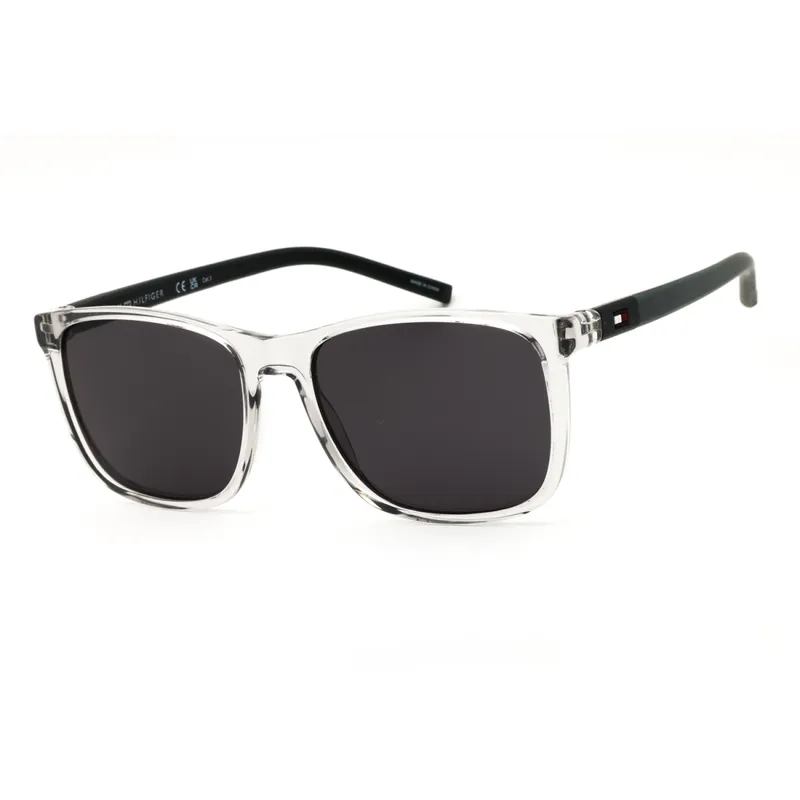
- Tommy Hilfiger TH2120/S: a square frame with a clear grey front, size 50-15-130, listed as polyamide.
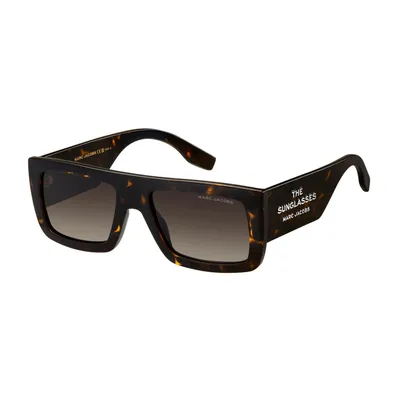
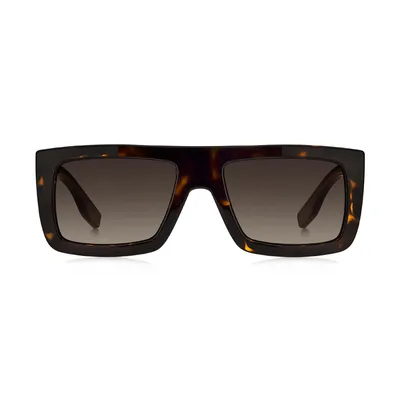
- Marc Jacobs MARC775/S in Dark Havana: a flat-top rectangle with no nose pads, size 53-18-145, listed as polyamide.
- Versace VE4426BU in white: a narrow oval with a solid bridge and no nose pads, size 54-18-145, listed as nylon.
- Tom Ford FT1196 Beatrice in Dark Havana: an oversized acetate cat-eye with a 65 mm lens and 140 mm temples.
- Kate Spade KENNA/G/S: a thin wire geometric frame, size 57-17-140, listed as stainless steel, for comparison with titanium.
To see more, browse Silhouette, Tom Ford and Versace, or start from women's sunglasses, men's sunglasses or unisex sunglasses.
FAQ
Is titanium lighter than acetate?
As a material, no: titanium is more than three times as dense. As a frame, usually yes, because a titanium frame is made from thin wire and uses far less material than a thick acetate one.
Is TR-90 the same as nylon?
TR-90 is a trade name for a nylon-type plastic used in moulded frames. Listings may say nylon, polyamide, TR-90 or Grilamid for closely related materials.
Are lighter sunglasses always more comfortable?
Not always. A light pair that does not fit will still slide or pinch. Fit at the bridge and temples, and how the weight is balanced between nose and ears, matter as much as the total weight.
Do the lenses change the weight?
Yes. Glass lenses weigh more than plastic lenses of the same size, and larger lenses weigh more than small ones.
How can I tell what a frame is made of?
Check Frame material in the details on the product page. Many listings only say metal or plastic, so the maker's own description is the best source when you need to know the exact material.
More guides
- What Makes Sunglasses Unisex? Men's vs Women's FramesWhat the unisex label on sunglasses means, how men's, women's and unisex frames really differ in size and shape, and how to pick by fit instead.Read the guide
- Lens Categories 0 to 4: How Dark Should Sunglasses Be?What sunglasses lens categories 0 to 4 mean, how much light each lets through, where each one fits, and why darker is not the same as UV protection.Read the guide
- Best Sunglasses for Driving: What to Look ForFor driving, pick grey or brown lenses in category 2 or 3, slim temples and a snug fit. Compare lens options and see pairs that suit the road.Read the guide