How to Read Sunglasses Sizes
GlareBear November 5, 2026 3 min read
The short answer
Look inside one temple for something like 55-19-140. The first number is the width of one lens, the second is the gap across the bridge, the third is the temple length, all in millimetres. The lens width is the one to compare with a pair you already wear.
Where the size is printed
Almost every pair carries its size on the inside of one temple, the arm that goes over your ear. It reads as three numbers, usually separated by a small square or dashes: for example 55□19 140, or 55-19-140. Some makers print the model code and colour code next to it. On a GlareBear page the same three numbers sit in the Details table under Fit, taken from the supplier's data.
What the three numbers mean
| Number | What it measures | Typical range |
|---|---|---|
| Lens width | The width of one lens at its widest point | About 48 to 62 mm |
| Bridge width | The gap between the two lenses, across your nose | About 14 to 24 mm |
| Temple length | From the hinge to the tip of the arm | About 130 to 150 mm |
Lens width is the number people mean when they call a frame small, medium or large. As a rough guide, under 50 mm is small, 50 to 54 mm is medium, 55 to 58 mm is large, and 59 mm and up is extra large. These are sunglasses conventions, not rules: a 55 mm aviator and a 55 mm cat-eye sit very differently on a face.
The number nobody prints: total width
The measurement that decides whether a frame looks right is the width of the whole front, from one outer edge to the other. It is roughly two lens widths plus the bridge plus a few millimetres of frame on each side. A 55-19 frame comes to about 135 to 140 mm across. Most adult faces sit somewhere between 125 and 145 mm at the temples, so a front that matches that width looks in proportion. If the frame is much wider than your face it slides down; much narrower and it pinches and leaves marks.
How a one-piece shield is measured
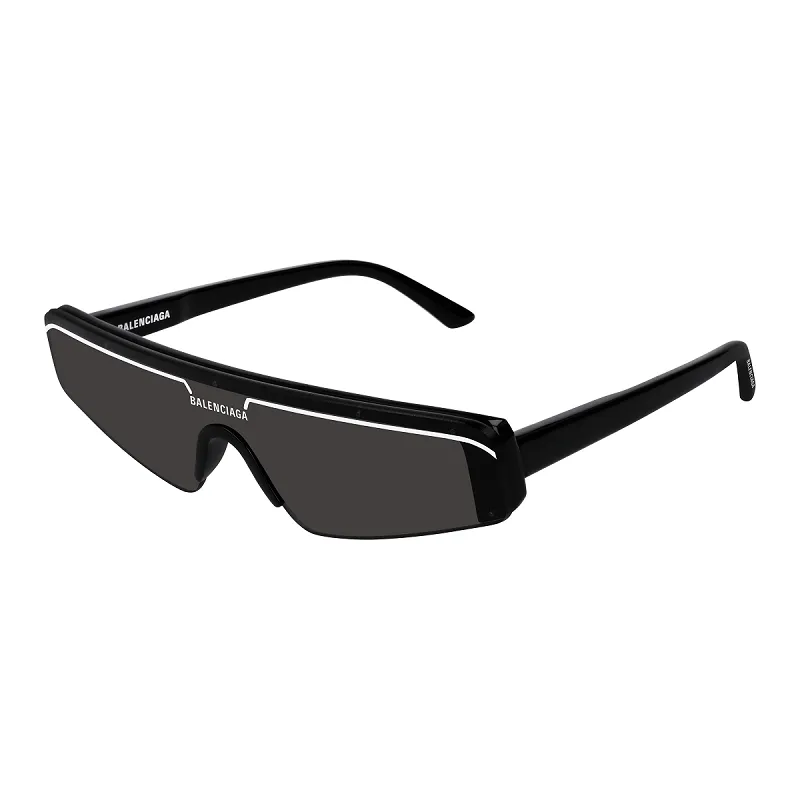
Shields and masks have one lens that runs the whole width of the face, so the usual lens-bridge-temple numbers do not quite fit. Makers still print three numbers. A size such as 99-1-140 means one lens about 99 mm across, a bridge listed as 1 mm because there is no separate bridge to measure, and 140 mm temples. Read the first number as the span of the lens, not as the width of one eye's lens. For width on the face, a shield behaves like a large wraparound.
Compare with a pair you own
- Find the size printed inside the temple of a pair that fits you well.
- Note the lens width. That is your reference number.
- On a new pair, a lens width within 2 mm of your reference, and a bridge within 2 mm, will usually feel familiar.
- Check the shape too: a rounder or taller lens of the same width covers more of your face.
If you have no pair to compare, measure your face across the temples with a soft tape or a ruler held in a mirror, and look for a frame whose total width is close to that figure.
Temple length and the fit behind the ear
Temple length matters less than lens width, because the arms bend to suit you. A 140 mm temple is the common length for adults; 145 and 150 mm arms suit larger heads or frames meant to sit low on the nose. Pairs ship exactly as the maker packed them, without any adjustment, and a local optician can bend the temples and nose rest to fit in a few minutes.
For the shapes themselves, see which sunglasses shape suits your face. For what the colour code after the size means, see model codes and colour codes.