
Guide
Oversized Sunglasses: How Big Is Too Big
GlareBear November 14, 2026 3 min read
The short answer
There is no official cutoff, but a lens width of about 57 mm and up is generally treated as large, and 60 mm and up as clearly oversized. A pair is too big when the frame is much wider than your face, the lenses sit on your cheeks, or it slides down when you look down. Check lens width and bridge width against a pair you already wear.
What counts as oversized
Makers do not agree on one rule. Oversized usually means a frame with big lenses that cover a lot of the face, often well past the brow and onto the cheek. The number that matters most is the lens width, the first of the three numbers printed inside the temple. GlareBear treats a lens width of 57 mm and up as wide on each pair's fit guide.
| Lens width | How it is usually described |
|---|---|
| Under 50 mm | Small |
| 50 to 56 mm | Medium |
| 57 to 59 mm | Large |
| 60 mm and up | Oversized |
Treat the bands as a rough guide. Lens height and shape change how big a frame looks. A tall 55 mm square can look bigger than a shallow 58 mm oval.
An example from the shop
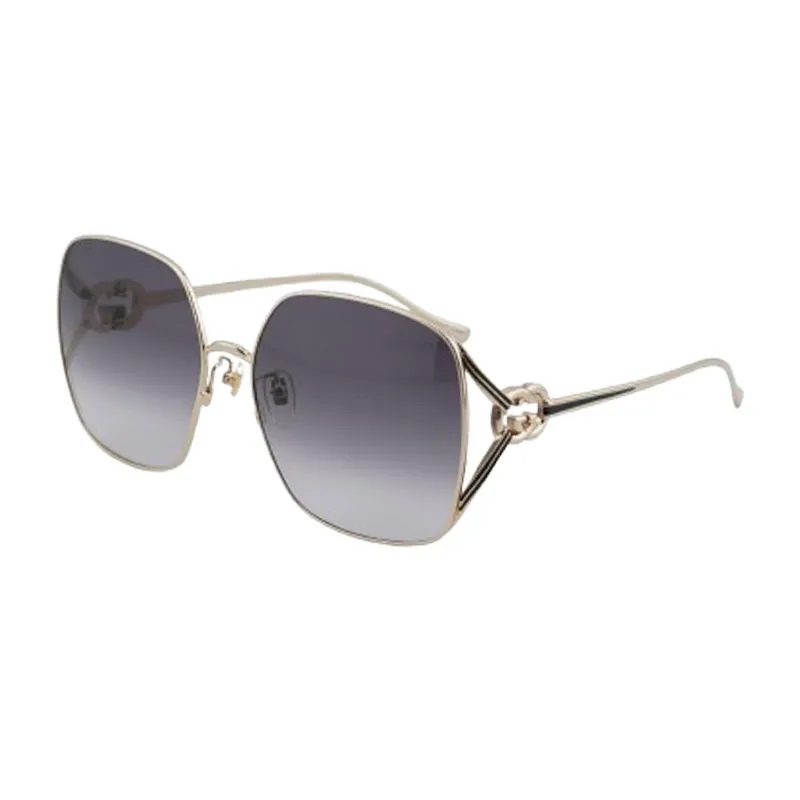
The Gucci GG1323S in gold is listed as an oversized square with a metal frame and grey gradient lenses. Its size is 63-17-130: a 63 mm lens, a 17 mm bridge and a 130 mm temple. The photos show a full rim all the way round each lens, so the front covers a lot of the face. It has adjustable nose pads, which helps with fit on a frame this large. More pairs from the same maker are on the Gucci page.
Signs a pair is too big
- The frame is clearly wider than your face at the temples.
- The lower rim rests on your cheeks and lifts when you smile.
- The pair slides down your nose when you look at the floor.
- Your eyes sit near the inner edge of each lens instead of the middle.
- The temples stick out at the sides instead of running straight back.
If you see one or two of these, a different bridge width or a lighter frame may fix it. If you see most of them, go down a size. Our guide on how to tell if sunglasses fit has a five-step check you can run in a mirror.
Who tends to wear oversized frames well
Big frames work on many faces, but proportion matters. A larger face carries a larger lens without looking swamped. A smaller face usually looks best in the lower end of the large range. Shape plays a part too: a rounded frame softens an angular jaw, and a squared frame adds structure to a softer one. Our guide on which shape suits your face goes through this, and round vs square sunglasses compares the two most common oversized shapes.
What to check before you buy
- Find the lens width on a pair you already wear and compare it with the new one. The fit guide on each pair's page shows where it falls between narrow and wide.
- Look at the bridge width. A wider lens with a narrow bridge can pinch, and a wide bridge on a small nose can slip.
- Check the temple length. Most pairs run 130 to 145 mm, and a short arm on a wide front can press behind the ears.
- Look at weight. A big metal or acetate front can feel heavier than it looks.
Browse by who the frame was cut for: women's, men's or unisex. If you are unsure how to read the numbers, start with how to read sunglasses sizes.
More guides
- Acetate vs Metal Sunglasses Frames: How to ChooseAcetate frames are thicker and hold rich colour. Metal frames are thinner and usually have adjustable nose pads. How to pick between them.Read the guide
- Shield and Wraparound Sunglasses, ExplainedShield sunglasses use one lens across both eyes. Wraparounds curve around the face. How they differ, how sizes work and who each one suits.Read the guide
- Sunglasses for Wide Faces: Sizes That WorkSunglasses for wide faces and larger heads: the lens widths and arm lengths that fit without pinching, and the shapes that look in proportion.Read the guide