
Guide
Round vs Square Sunglasses: How to Choose
GlareBear November 13, 2026 3 min read
The short answer
Round sunglasses have curved lenses that soften the face, while square sunglasses have straight edges and corners that add structure. A common starting point is to pick the opposite of your face shape: round frames for angular faces, square frames for round or soft faces. Both shapes come in every size, so check the lens width, bridge and temple numbers against a pair that already fits.
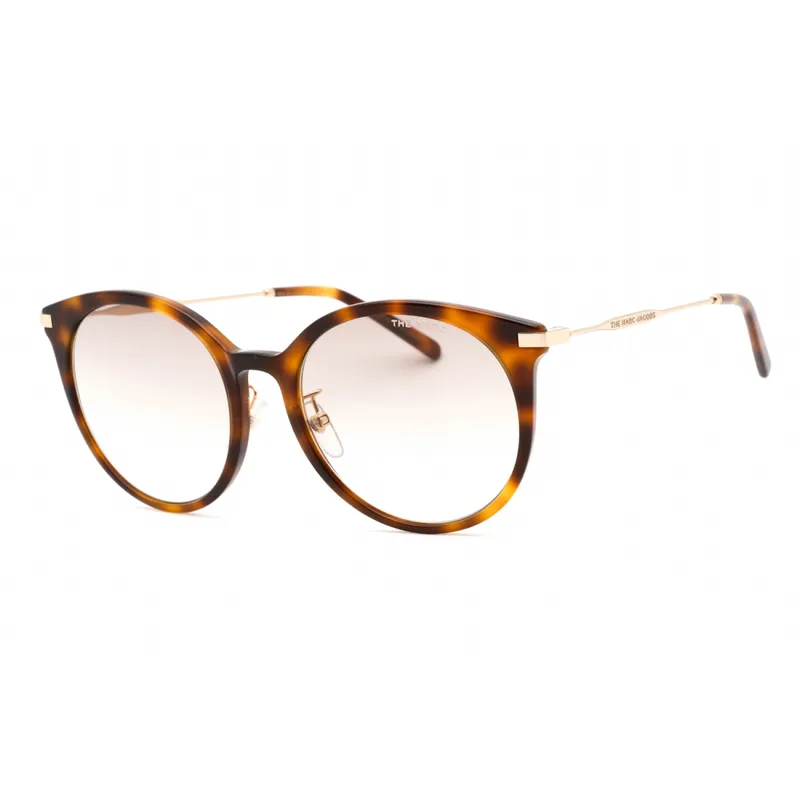
The difference in one look
The shape of the lens is the whole story. A round frame has lenses with no corners, from a perfect circle to a soft oval. A square frame has a flat or nearly flat brow, straight sides and clear corners. Many frames sit somewhere in between, so treat these as two ends of a range rather than two boxes.
| Round | Square | |
|---|---|---|
| Lens outline | Curved all the way round | Straight top and sides, with corners |
| Effect on the face | Softens strong lines | Adds structure and definition |
| Brow line | Follows the curve of the lens | Usually flat, often a little heavier |
| Overall feel | Relaxed, often a little retro | Classic and polished |
Two examples from our shelves
The Marc Jacobs MARC552/G/S in Havana is a full-rim round frame with adjustable nose pads and thin gold-coloured temples. Its page lists the size as 54-19-145. The Marc Jacobs MJ1094/S in Havana is a square with a flat brow, squared corners and a nose rest moulded into the frame. Its page lists the size as 55-17-140. The two lens widths are only 1 mm apart, yet the frames look very different on a face, which shows how much the outline matters.
Which faces each shape tends to suit
The usual advice is to choose a frame that contrasts with your face shape. Stylists and opticians do not all agree on the details, so use this as a starting point and trust the mirror.
- Round faces: square frames add angles and can make the face look a little longer.
- Square or angular faces: round frames soften a strong jaw and brow.
- Heart-shaped faces: round frames with a light brow keep the top half from looking heavy.
- Oval faces: both shapes usually work, so choose by taste.
- Long faces: a deeper square frame can break up the length.
Our guide to which sunglasses shape suits your face covers the other shapes too.
Comparing sizes before you choose
Shape changes how a size feels. A square lens covers its corners, so it usually looks larger than a round lens with the same width. A round lens is often shallower top to bottom, so check that your eyes would sit near the middle of it and not close to the top edge. Read the three numbers on each page and compare them with a pair you already own. Our guide to reading sunglasses sizes explains what each number means, and the guide on how to tell if sunglasses fit has a quick routine for when the pair arrives.
Where to start
If you are unsure, start with a softened version of either shape: a square with rounded corners or a round frame that is slightly flat across the top. Both are easy to wear. Browse women's sunglasses, men's sunglasses or unisex sunglasses, or see every maker on the brands page.
More guides
- Acetate vs Metal Sunglasses Frames: How to ChooseAcetate frames are thicker and hold rich colour. Metal frames are thinner and usually have adjustable nose pads. How to pick between them.Read the guide
- Shield and Wraparound Sunglasses, ExplainedShield sunglasses use one lens across both eyes. Wraparounds curve around the face. How they differ, how sizes work and who each one suits.Read the guide
- Sunglasses for Wide Faces: Sizes That WorkSunglasses for wide faces and larger heads: the lens widths and arm lengths that fit without pinching, and the shapes that look in proportion.Read the guide