
Guide
Shield and Wraparound Sunglasses, Explained
GlareBear November 16, 2026 4 min read
The short answer
A shield has one continuous lens across both eyes instead of two separate lenses. A wraparound is any frame that curves to follow the face, so the sides sit close to your temples. The two overlap: many sport pairs are both. Shields are mostly a style choice, while a wraparound is the practical one when you want less light and wind coming in from the sides.
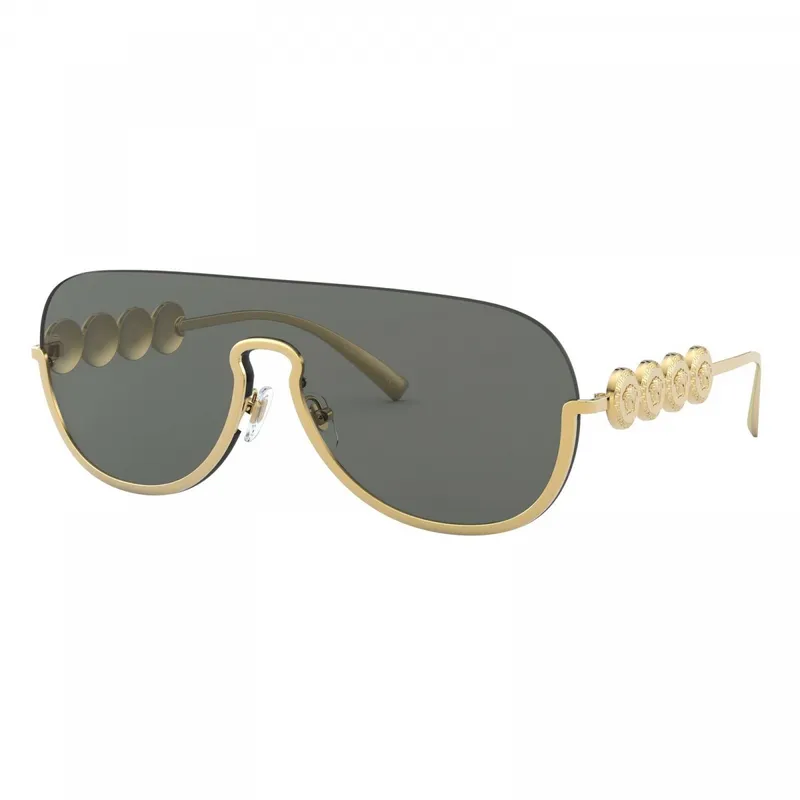
Shield vs wraparound at a glance
The two words describe different things. Shield is about the lens. Wraparound is about the curve of the frame. A pair can be one, the other or both.
| Shield | Wraparound | |
|---|---|---|
| What defines it | One lens that runs across both eyes | A front that curves back towards the temples |
| Lenses | One | One or two |
| Seen from above | Can be nearly flat or curved | Clearly curved |
| Usual setting | Fashion, and sport when curved | Sport, driving, wind and water |
| Main appeal | A clean, unbroken front | Coverage at the sides |
What makes a shield
On a normal frame, two lenses sit either side of a bridge. On a shield, a single lens covers both eyes and a cut-out in the lens, or a small nose piece fixed to it, takes the place of the bridge. Some shields have a full rim, some have a rim along one edge only and some have no rim at all.
The Versace VE2215 in gold is a clear example of the fashion kind. It has one long grey lens, a thin gold metal rim along the bottom edge only, and a straight, unframed top.
What makes a wraparound
A wraparound front bends so the outer edges of the lenses sit closer to your face than the middle does. Opticians describe this with the base curve of the lens. The higher the number, the more curved the lens. Everyday fashion frames are fairly flat, and sport wraparounds are often around base 8. Makers differ, and most do not print the base curve on the frame.
The curve does two jobs. It closes the gap at the sides where light, wind and dust come in, and it helps the frame grip the head when you move. The Adidas SP0070 in grey is a unisex wraparound of this kind, with a rim along the top only and the lower edge of the lens left open.
How the sizes work
Most sunglasses carry three numbers: lens width, bridge width and temple length. Our guide to reading sunglasses sizes covers them. Shields and wraparounds bend those rules.
- Shields: there is no separate bridge, so a bridge number may be missing. The lens number may be the width of the whole shield, such as 99 mm, or it may be left out. Makers differ, so check which one a page is giving you.
- Wraparounds: the lens is measured the usual way, but a curved front sits closer than a flat one with the same numbers. Lens widths of 60 mm and more are common and do not always mean the pair will look big.
- Temple length works the same as on any frame. Compare it with a pair you already wear.
Who each one suits
- A flat fashion shield is a bold look. It covers a lot of the face, so it works best when its width is close to the width of your face. See how big is too big for the checks.
- A wraparound suits running, cycling, fishing, boating and long drives, where side glare and wind are the problem.
- If your lashes or cheeks touch the lens on a curved pair, the curve is too tight for your face. Try a flatter frame.
- If a frame slides when you look down, run through the checks in how to tell if sunglasses fit.
Things to know before you choose
- A one-piece lens has more surface to scratch, and a scratch in the middle is hard to ignore. Keep a shield in its case. Our care guide has the basics.
- Strongly curved pairs often do not fold as flat as other frames, so they may need a deeper case.
- Shape tells you nothing about the lens itself. Tint, mirror coating and polarization are separate choices, covered in lens colours explained and polarized or not.
Where to start
Both kinds turn up across women's, men's and unisex sunglasses. Each pair's page lists its frame shape under Details. For sport wraparounds, look at brands that make them their main line, such as Nike, Adidas and Bolle.
More guides
- Acetate vs Metal Sunglasses Frames: How to ChooseAcetate frames are thicker and hold rich colour. Metal frames are thinner and usually have adjustable nose pads. How to pick between them.Read the guide
- Sunglasses for Wide Faces: Sizes That WorkSunglasses for wide faces and larger heads: the lens widths and arm lengths that fit without pinching, and the shapes that look in proportion.Read the guide
- Sunglasses for Small Faces: Sizes That WorkSunglasses for small or narrow faces: the lens widths, bridge sizes and shapes that fit, and the styles that tend to overwhelm a petite face.Read the guide